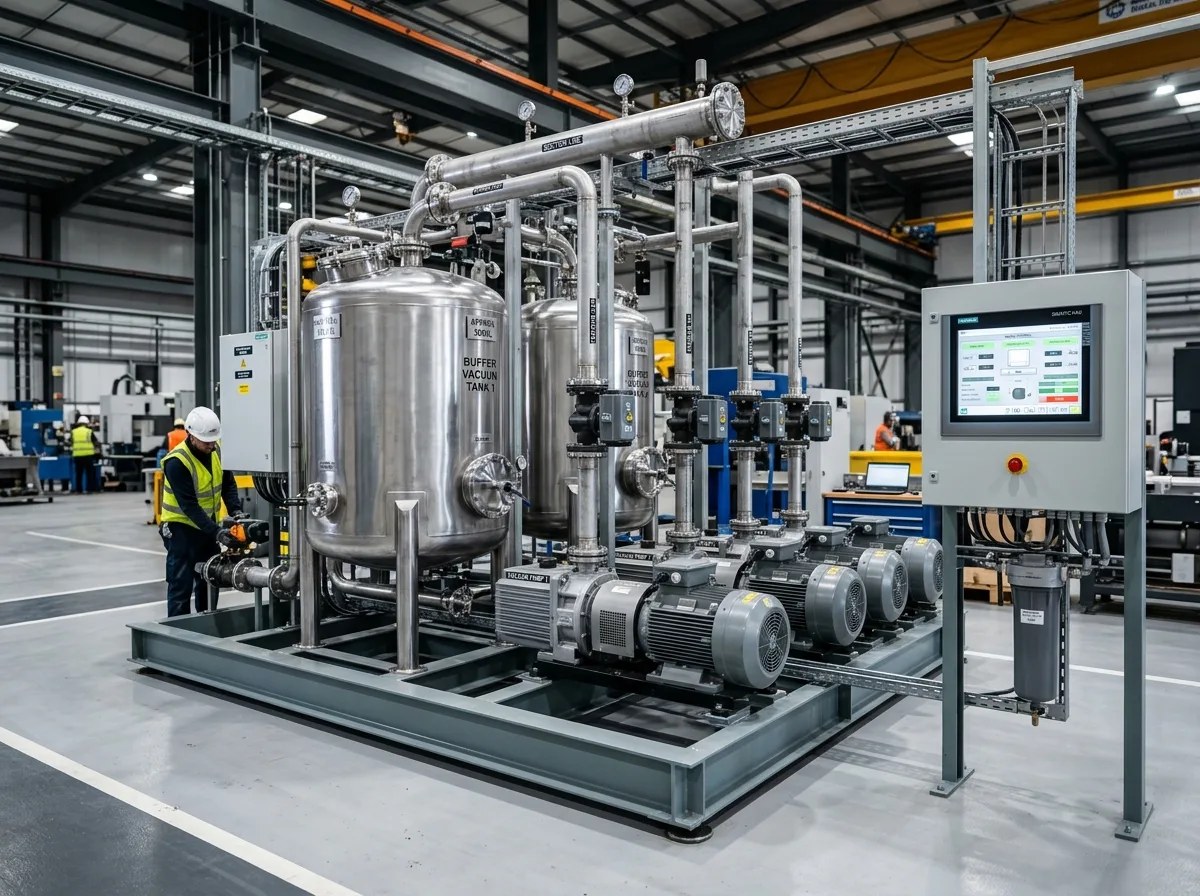
Properly dimensioned pumps and tanks only operate efficiently with a well-designed piping system. A significant portion of common issues in central vacuum systems stem not from the pump, but from narrow pipes, unnecessary elbows, and undetected leaks.
Why is pipe diameter important?
In a vacuum line, air loses pressure due to friction as it flows through the pipe. This loss increases as the pipe diameter decreases and the line lengthens. As a result, even if the tank vacuum is sufficient, the required vacuum does not reach the machine at the end of the line. The main line diameter must be selected to maintain an acceptable pressure loss up to the furthest point of consumption.
Points to consider in piping design
- Keep the main line as short and straight as possible; use large-radius elbows instead of sharp elbows.
- In large facilities, a ring main provides supply to the machines from two directions, reducing pressure differentials.
- Install a shut-off valve at each machine connection so it is not necessary to shut down the entire system during maintenance.
- Route the line with a slight slope toward the pump and install drain points at the lowest locations to prevent condensed moisture from reaching the pump.
- In dusty applications, add filters at machine outlets to prevent contamination of the line and pumps.
Leaks: Unseen energy loss
A loose fitting, a worn hose, or a left-open valve causes the pump to run continuously and increases energy consumption. A simple way to detect leaks is to evacuate the system when there is no production, stop the pumps, and monitor how quickly the tank pressure rises. If the pressure rises rapidly, there is a leak in the line.
- Regularly check connection points, hoses, and suction cups.
- Seal unused connection points.
- Record pump operating hours; an increase in operating time while production remains the same is an indicator of a leak.
If you are experiencing low vacuum or high energy consumption in your existing piping system, our service team can inspect your system on-site and report improvement recommendations.