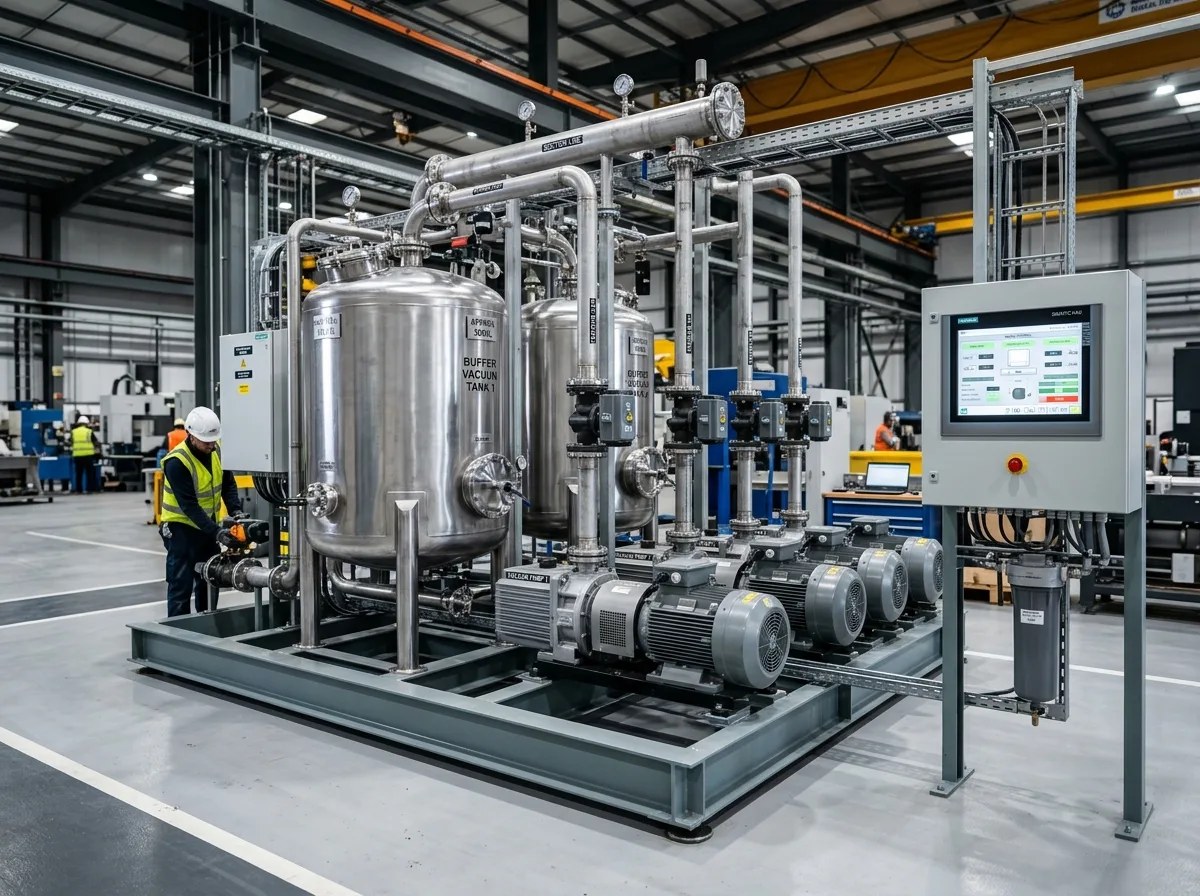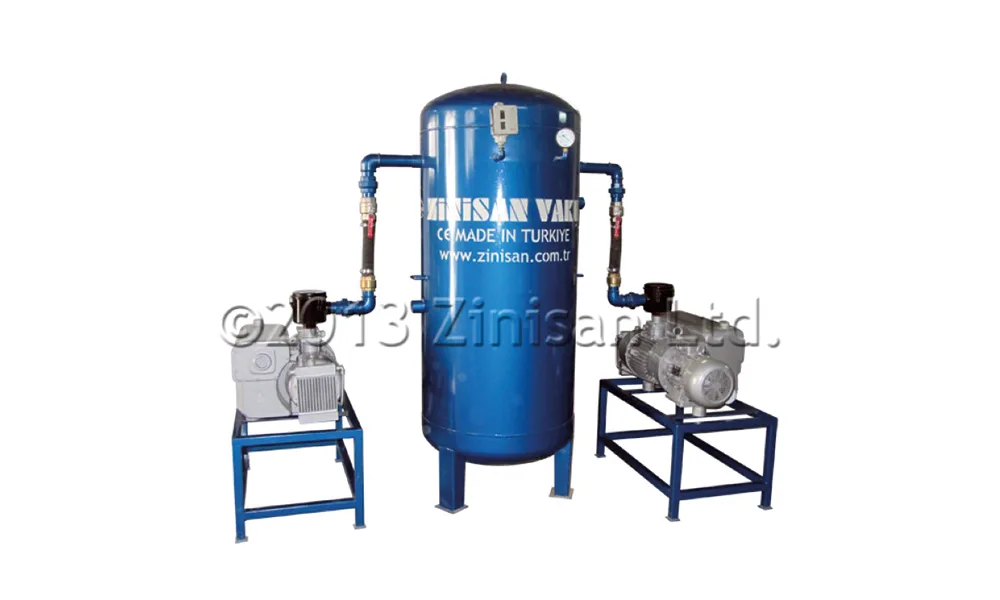
There are two fundamental decisions in the design of a central vacuum system: the volume of the vacuum tank and the number and capacity of the pumps to feed the tank. Together, these two values ensure that the system can respond to instantaneous demands while preventing the pumps from cycling on and off unnecessarily frequently.
Determining the total vacuum demand
The first step is to list all consumption points to be connected to the system. The required displacement and operating pressure for each machine are determined. Then, the simultaneous operation rate (coincidence factor) of these machines is estimated. It is rare for all machines to operate at full capacity at every moment; a realistic coincidence factor prevents the system from being oversized.
The function of the tank volume
The vacuum tank acts as a buffer:
- It prevents rapid pressure drops when a machine suddenly draws a large volume.
- It reduces the frequent and continuous cycling of the pumps on and off, which extends the service life of the motor and contactor.
- It provides a short-term vacuum reserve in situations such as power outages.
If the tank is selected too small, the pumps will cycle on and off very frequently; if selected larger than necessary, the time required to reach the vacuum upon initial commissioning will increase, resulting in a waste of space. The tank volume, pump displacement, and acceptable pressure range must be evaluated together to determine the optimal configuration.
Single pump or multiple pumps?
Meeting the total demand with a single large pump may seem simple at first glance; however, a multi-pump system provides the following advantages:
- Only one pump operates during low demand, ensuring energy savings.
- Production does not stop when one of the pumps is under maintenance.
- The control panel balances wear by equalizing the operating hours of the pumps.
In critical production lines, it is recommended to plan for a standby pump (N+1) in addition to the total demand.
The ZVS series offers options with 1 to 4 pumps and tank capacities ranging from 25 to 5000 liters. If you contact us with your machine list and operating conditions, we can jointly calculate the tank and pump layout.